


Inside Grace AI Lab’s Goal-Oriented AGI Architecture: Why It Outperforms Generic AI
Published by Borderless MediaNg
AGI Nigeria, agentic AI architecture, AI agents Africa, autonomous AI systems, goal-oriented AI, Nigerian AI startup The AI agent space is crowded. Everyone is shipping “agents” but most of them are glorified chatbots with a loop attached.
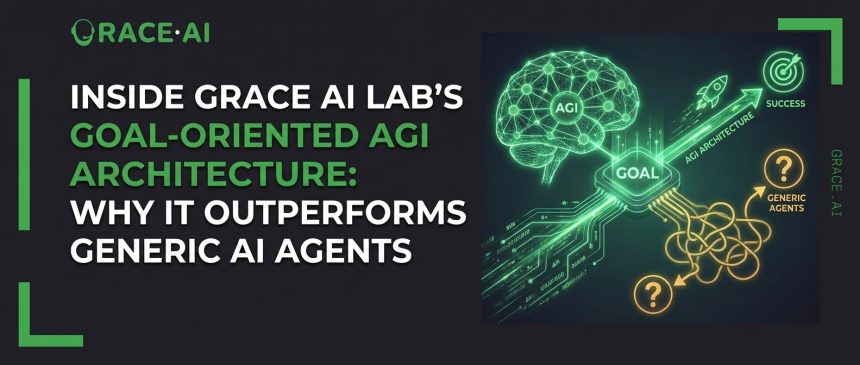
Grace AI Lab, a Nigerian AI company building autonomous digital workers, is taking a fundamentally different approach. Their secret? A goal-oriented AGI-base architecture that changes how agents think, plan, and execute.
Here’s why it matters and why it outperforms generic implementations. The Problem with Most AI Agents
Most AI agents today are reactive. They receive a prompt, generate a response, maybe call a tool, and return output. They’re essentially LLMs with extra steps.
This works for simple tasks. It fails catastrophically for complex workflows that require: Multi-step planning across different systems. State management over extended operations. Error recovery without human intervention. Optimization toward specific business outcomes.
The result? Agents that demo well but break in production. Agents that require constant babysitting. Agents that enterprises can’t actually trust with real work. Goal-Oriented Architecture: A Different Foundation Grace AI Lab’s approach starts from a different premise: agents should be goal-driven,
not prompt-driven. In their architecture, agents receive objectives not just instructions. The system then: Decomposes goals into sub-tasks autonomously. Plans execution paths considering dependencies and constraints. Maintains state across multi-step operations. Self-corrects when encountering obstacles. Optimizes for the defined success criteria not just task completion.
This is the difference between telling someone “send an email” and telling them “ensure customer satisfaction improves by 20% this quarter.” The first is a task. The second is a goal and it requires fundamentally different cognitive architecture to pursue effectively.
Why This Matters for Enterprise Deployment For enterprises, the implications are significant:
Reliability. Goal-oriented agents can recover from failures because they understand the objective, not just the procedure. If step 3 fails, they can find alternative paths to the goal.
Scalability. Instead of programming every edge case, you define goals and constraints. The system figures out execution. This scales across use cases without proportional engineering effort.
Measurable outcomes. Because agents are optimizing for goals, you can measure success against business metrics, not just task completion rates. “If your ‘AI agent’ only answers questions, it’s not an agent,” says Divine Matthew, Founder of Grace AI Lab. “It’s a chatbot with better marketing. “The Technical Differentiator
While Grace AI Lab keeps proprietary details close, the architectural principles are clear: treat AI agents as goal-pursuing entities, not instruction-following tools. For Nigerian startups building in the AI space, this represents a strategic insight worth considering.
The market is saturated with wrapper products. The opportunity lies in building differentiated architectures that solve real deployment challenges. Grace AI Lab is proving that this kind of technical depth can be built from Lagos and that it can compete globally.
For further enquires visit graceagent.co
